
BYD Battery-Box Premium HVM 11.0 review
Australian model: HVM 11.0
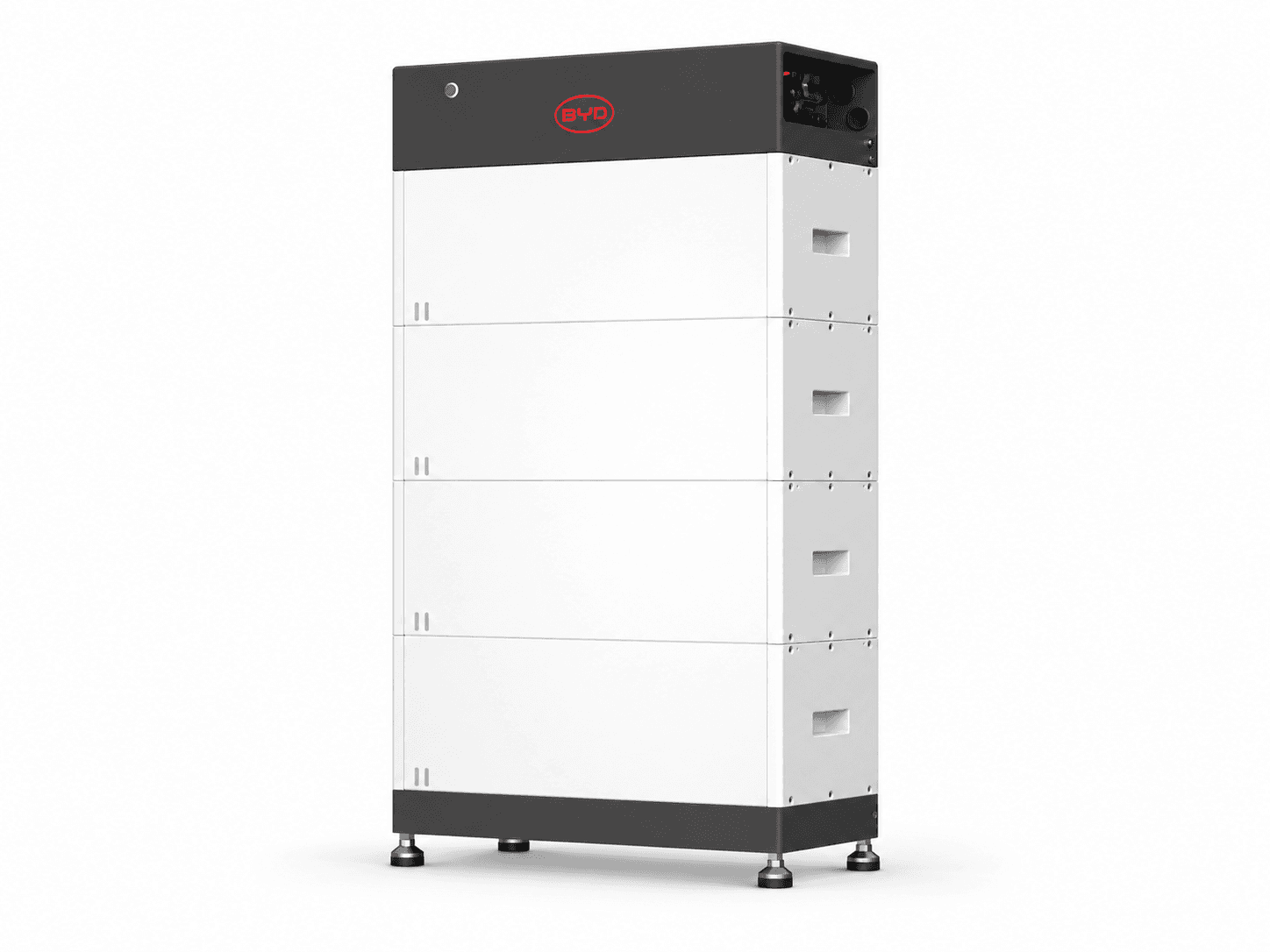
A four-module, high-voltage battery tower with 11.04 kWh of usable DC storage. It needs a compatible inverter, so the battery and inverter should be chosen as one installation.
Manufacturer sources checked 20 Sep 2026.
Our verdict
A useful modular option when your chosen inverter supports four HVM modules, with backup performance set by that inverter and a throughput limit on the capacity warranty.
- Good fit for
- Homes planning storage around a BYD-listed high-voltage inverter, with room to expand the battery tower later.
- Consider another option if
- You want a battery with its own AC inverter, or your proposed inverter cannot support the four-module HVM configuration.
At a glance
- Usable capacity
- 11.04 kWh
- Battery-side DC usable energy under BYD's test conditions; energy available from the complete system varies with the inverter.
- Source
- Household AC output
- Depends on inverter
- The Australian datasheet's 10.24 kW is rated battery-side DC power, not guaranteed AC or backup output.
- Source
- Performance warranty
- 10 years or 34.15 MWh
- Whichever comes first, with 70% usable-energy retention. The clock starts at the original buyer's invoice date; conditions apply.
- Source
- Installed price
- Itemised quote needed
- No fixed manufacturer installed price verified. Include the inverter, controller, backup equipment and installation.
- Source
Strengths
- Four HVM modules provide 11.04 kWh usable DC storage in one tower.
- The HVM design allows extra modules, subject to the inverter's permitted configuration.
- BYD lists inverter options from several manufacturers, each with module-count and firmware requirements.
Limitations
- A battery tower alone does not provide an AC connection or establish which household loads receive backup.
- The warranty includes installation within one month of the invoice date and access to performance data after a claim.
System essentials
Four-module HVM tower
SourceFour HVM battery modules form the reviewed tower. Include its control unit and base in the quote, identifying the control-unit generation.
BYD-listed inverter
SourceA separate compatible high-voltage inverter converts stored energy to AC. Its exact row must permit four HVM modules and the installed firmware.
Backup design and commissioning
SourceSpecify the backed-up circuits, required switching equipment and commissioning in the installation quote; these depend on the inverter and site.
Capacity and power
This review covers HVM 11.0: four HVM modules in one tower, using BYD's original HVS/HVM Australian document set. BYD publishes separate BCU 2.0 documents, so a quote using that newer control unit needs its own configuration check. HVS modules and other tower sizes are outside this review.
The usable capacity above is measured on the DC side at 100% depth of discharge, 0.2C charge/discharge and 25°C. It is not a promise of that much energy at your power points. The inverter affects delivered energy and simultaneous appliance power; battery power also reduces at low temperatures.
HVM towers can contain three to eight modules, but expansion must remain within the inverter's permitted module range. Have future module additions and commissioning work specified before treating expansion as a simple later purchase.
Backup and installation
Choose the inverter and backup design together. BYD's compatibility list sets both module counts and minimum firmware. Being listed for another HVM size does not establish support for this four-module tower.
The battery documentation permits backup with compatible inverters; it does not define a universal backup box or whole-home output. Ask which circuits and phases will stay powered, which starting loads the inverter can handle, and whether solar can recharge the system during an outage. Have a qualified installer commission the complete combination and explain its reserve settings.
Warranty and ownership
The Australian warranty provides ten-year defect cover from the original buyer's invoice date. Its separate performance promise retains 70% usable energy until ten years or 34.15 MWh of recorded output, whichever comes first. More frequent cycling can reach that operating limit sooner.
The conditions include installation within one month of the invoice, a BYD-listed inverter, manual-compliant operation and temperatures within −10°C to 50°C. Report defects within 30 days of becoming aware of them; six months without operation is another listed limitation.
BYD requires Internet access to performance data when requested after a claim. Keep the invoice, configuration and commissioning records. The warranty does not name VPPs: confirm how your intended program fits its normal-use condition. Subsequent owners can claim with proof of ownership. Australian Consumer Law rights remain.
Brand and Australian support
Support evidence checked 21 September 2026. BYD’s contact page names Alps Power in Peakhurst as Australian authorised service partner. The download index separates original BCU and BCU2.0 documents; a separately verified commencement date for this stationary-battery arrangement was not found. Confirm the quoted BCU because the warranty and inverter row follow that identity.
The reviewed original BCU uses Australian HVS/HVM warranty V1.1, created 8 October 2024. It promises no-charge repair/replacement or a formula-based partial refund, sends claims to Alps with BYD Global Service as fallback, and may invoice a no-cover or no-fault inspection. It does not expressly promise owner labour, travel, removal/reinstallation or freight for an accepted ordinary claim; out-of-warranty parts, labour and travel are owner-paid. The separately checked BCU2.0 V1.0 warranty uses the same remedy and cost framework, but does not replace V1.1 as this review's source. Australian Consumer Law rights remain separate.
The final ARENA/ITP report tested one earlier-BCU HVM 11.04 kWh lab system and reported no apparent capacity fade after about 1,180 cycles. One controlled unit cannot establish current BCU2.0 field reliability or support outcomes. No HVM 11.0/BCU entry appeared in the ACCC, CEC or Energy Safe Victoria searches, and no bounded Australian owner/installer dataset separating BCU generation was verified.
Price and alternatives
We found no fixed manufacturer installed price in the material checked. Request an itemised quote for the four modules, control unit, base, compatible inverter, backup equipment, installation and GST. Current documentation does not confirm local stock or lead time.
Find BYD's sales and Australian service contacts for product enquiries and warranty clarification. Obtain the installed price from your supplier; the contact page is not an installed-price offer.
If retaining your existing inverter makes this combination unsuitable, compare batteries with their own inverter in the solar-battery catalogue. Match the usable storage and backed-up loads in each complete quote. Rebate and approval status were not reverified here; check the proposed equipment and installation before deducting an incentive.
Who it suits
Take your overnight energy use and essential-appliance list to the installer. Ask for a four-module compatibility check, an outage-load plan and the exact control-unit version. If expansion or VPP participation matters, resolve those requirements before buying the tower: extra storage cannot by itself fix an unsuitable inverter or backup design.
Check the model in your quote
Check that your quote names this exact model and configuration.
Reviewed configuration
HVM 11.0
11.04 kWh usable
Battery-side DC usable energy under BYD's test conditions; energy available from the complete system varies with the inverter.
Other models in the family
Specifications, warranty terms and installation requirements can differ between models. Check current availability with your supplier.
- HVS 5.15.12 kWh usable
- HVS 7.77.68 kWh usable
- HVS 10.210.24 kWh usable
- HVS 12.812.8 kWh usable
- HVM 8.38.28 kWh usable
- HVM 13.813.8 kWh usable
- HVM 16.616.56 kWh usable
- HVM 19.319.32 kWh usable
- HVM 22.122.08 kWh usable
VPPs that list BYD Battery-Box Premium
Compare programsThese programs list the battery family. Your exact battery, inverter and address still need approval; inclusion does not confirm warranty cover. How VPPs work.
This program requires an electricity account with the provider. If you already use that retailer, a switch may not be needed; a particular plan may still be required.
Compare the required electricity plan as well as VPP rewards. Credits are before electricity costs and any program fees.
1 family listing · Program A–Z
Amber
SmartShift
Listed: NSW · VIC · SA · ACT · QLD (Energex)
- Reward snapshot
Variable wholesale export earnings
Automation responds to market prices. There is no fixed export rate or guaranteed return.
- Program costs
$25/month membership
Setup fee unknown. No exit fee. Additional charges may apply.

Reward snapshots — open the program for all credits, tariffs and conditions.