
Explainer
What is a VPP, and should your battery join one? (2026)
A virtual power plant coordinates home batteries to support the grid. You give the operator some control in return for a credit, export payment or access to wholesale prices — and the electricity plan can matter as much as the reward.
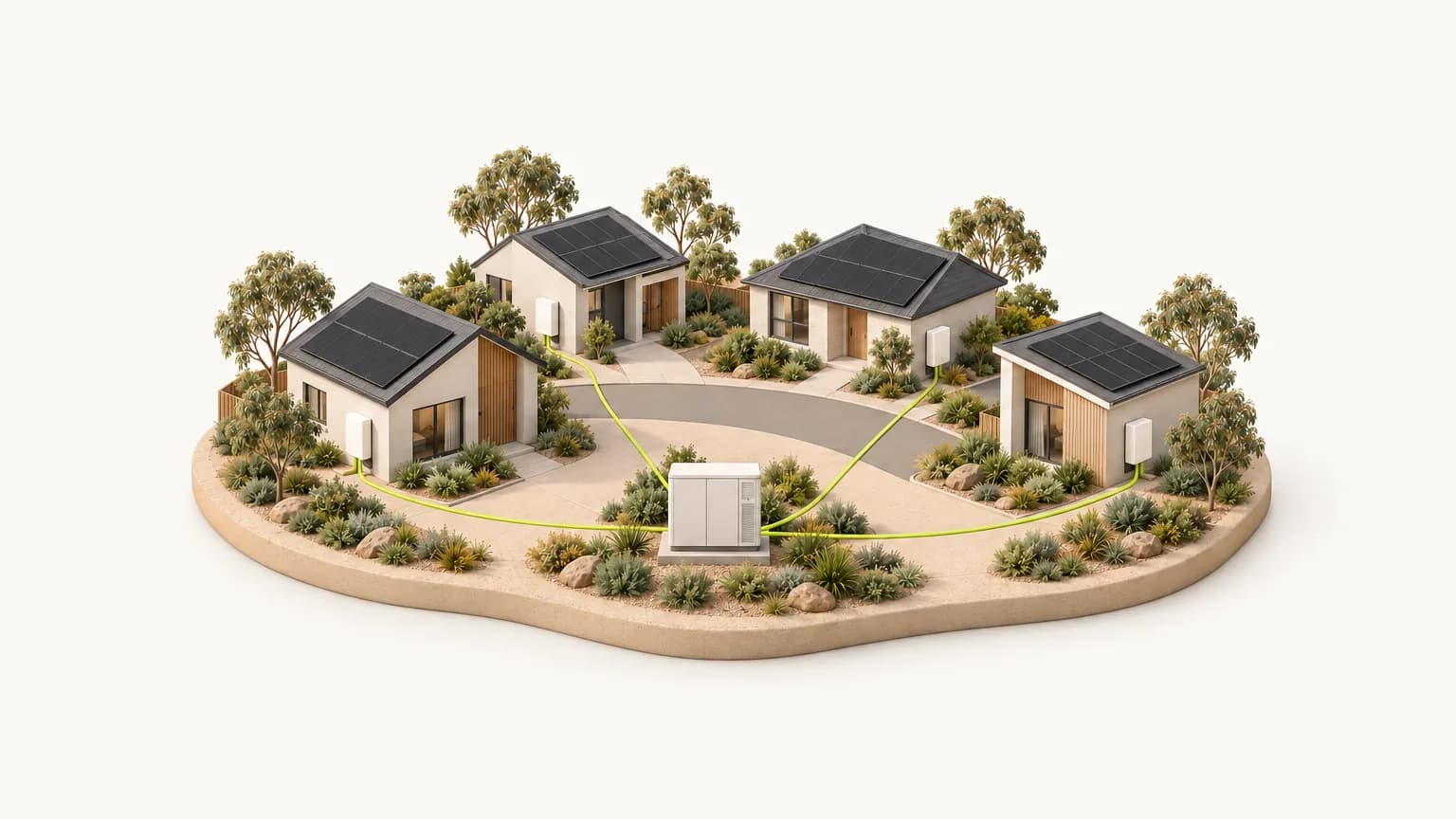
What joining a VPP means
Quick answer: a virtual power plant, or VPP, is a network of home batteries coordinated by a retailer or another operator. Joining can earn a financial reward, but it also lets the operator charge, hold or discharge your battery under the program's rules. The decision is worthwhile only after you compare the reward with the required electricity plan, control settings and exit terms.
A VPP uses software to make many small batteries respond as one larger energy resource. ARENA explains that an operator can aggregate household systems to supply stored energy, balance demand and provide grid services. No new power station appears at your house; the connection and remote controls already built into the battery do the work.
Your battery still stores solar and supplies your home. The VPP adds another set of instructions. The operator may prepare the battery for an expected grid event, discharge it when electricity is scarce or hold energy until a later period. In return, the household receives the payment defined by that program.
What the operator can do with your battery
The operator sends instructions through the internet to the battery or inverter. A dispatch may charge the battery, preserve its energy or export energy to the grid. The federal program's eligibility guidance requires an ongoing internet connection to participate in a VPP; the separate capability test asks whether an on-grid system can communicate and respond to external signals.
The amount of control varies. Some programs let you pause an event or set a backup reserve; others give the operator broader control while you remain enrolled. A grid-export floor, a household-discharge floor and the capacity available during an outage are different settings. Confirm each one rather than treating a stated “reserve” as a guarantee that energy remains available for every purpose.
A dispatch cap is different again: it limits how much energy the operator can call on over a stated period. Neither a reserve nor a cap should be assumed unless the program publishes it. Outage backup also depends on compatible hardware and installation. Federal household guidance says some VPPs reserve part of a battery for backup, but that is not a universal program feature.
How VPP payments work
VPP compensation usually has one or more of these shapes. The label matters because a fixed credit, an event payment and a wholesale price carry different certainty.
| Payment | How it works | What to check |
|---|---|---|
| Signup credit | A one-off credit for enrolling an eligible system. | Payment timing, minimum term and clawback conditions. |
| Ongoing credit | A recurring credit while you remain eligible. | Frequency, conditions, annual cap and missed-payment rules. |
| Event payment | A rate for eligible energy during an operator-called event. | Eligible hours, event frequency, caps, and whether it replaces or adds to the normal feed-in rate. |
| Market-linked price | Imports and exports follow wholesale prices. | Membership cost, price exposure and how automation manages spikes. |
The program's electricity plan sits beside those payments. A retailer or plan requirement can change daily supply charges, time-of-use rates and solar feed-in rates across every bill. Existing customers may already meet the retailer condition, but they still need to confirm the applicable plan. Compare the whole arrangement with your current one before treating a VPP credit as a gain.
When joining can make sense
A VPP can suit a household whose compatible battery has energy available when the program values it, and whose applicable retail plan still works for the household's import and export pattern. It can also suit someone comfortable giving the operator the published level of control.
The ACCC's June 2026 inquiry does not establish a national VPP-only saving. It found lower median bills for VPP customers than for customers without solar or batteries, but that comparison does not isolate the VPP: the groups also differ in solar and battery ownership, location, tariffs and electricity use.
Use the published terms instead. Put fixed costs beside credits that are actually fixed, keep conditional, event and market-linked payments labelled as uncertain, and check the retail plan. A program with a striking reward can still be a poor match if its peak usage rate catches much of your grid consumption or its control settings conflict with your backup needs.
Check these terms before joining
Use this checklist with the offer documents for your address:
- Retail plan: Must you change retailer or move to a named plan? Compare supply, usage and feed-in rates with your current bill.
- Payment conditions: Separate unconditional recurring credits from conditional, capped, event-based or market-linked amounts.
- Battery control: Confirm export and household reserve settings, any dispatch cap and whether you can override or pause an event.
- Compatibility: Check the exact battery, inverter and configuration, not only the brand name.
- Warranty and cycling: Ask the manufacturer and provider whether VPP dispatch changes warranty conditions or throughput limits.
- Contract and exit: Look for the minimum term, cooling-off period, exit fee and treatment of credits already paid.
- Address eligibility: Confirm the state, distribution network, postcode and meter requirements with the provider.
A comparison page can narrow the field, but the provider makes the final eligibility decision. Keep a copy of the plan fact sheet and VPP terms you accepted so later changes can be checked against them.
Capability is not compatibility
On-grid battery systems receiving the federal Cheaper Home Batteries Program discount must meet the program's VPP-capable requirements. In broad terms, the system must be able to connect, communicate and respond to external signals. An off-grid system has a stated exception, and no household is required to join a VPP merely because the system is capable.
“VPP-capable” does not mean “accepted by every VPP.” Providers support particular battery and inverter combinations, and software or communications requirements can exclude another model from the same brand. The ACCC also found that compatibility varied across the battery brands and VPP products it examined in 2026.
Check the provider's live compatibility tool or written confirmation for the exact installed system. If you are buying a battery with one VPP in mind, get that confirmation before installation and ask what happens if compatibility later changes.
The federal battery rebate guide explains the capability rule and current installation eligibility in detail.
Compare the programs open to you
Check payments, costs, retailer requirements, battery compatibility and control terms side by side.
Compare VPPsPrimary sources (4)
- How solar pays for itself, and how batteries reduce bills — energy.gov.auwww.energy.gov.au/solar/financial-benefits-solar/how-solar-pays-itself-and-batteries-reduce-bills
- What are virtual power plants and why do they matter? — ARENAarena.gov.au/blog/what-are-virtual-power-plants-and-why-do-they-matter
- Inquiry into the National Electricity Market, June 2026 — ACCCwww.accc.gov.au/system/files/inquiry-national-electricity-market-report-june-2026.pdf
- Eligibility information — Cheaper Home Batteries Program, DCCEEWwww.dcceew.gov.au/energy/programs/cheaper-home-batteries/eligibility-information