
Camping power
How long will a battery run a camping fridge?
By CompareVolt
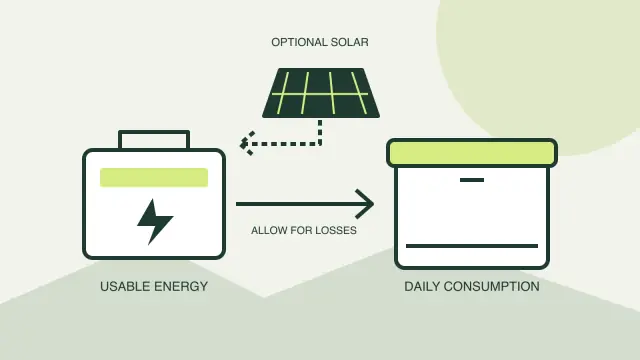
Divide the energy you can actually use by the fridge’s average daily consumption, allowing for reserve and delivery losses. Use the estimator below to test your own measurements and a separate solar scenario.
The quick calculation
A hypothetical 1,000 Wh usable battery, with 20% kept in reserve, can run a fridge using 400 Wh/day for about 43 hours at 90% delivery efficiency. That is a worked example, not a tested fridge or power station result. Hotter conditions, freezer settings, other loads and low-voltage cut-outs can shorten it.
The no-solar calculation is:
- Available energy = usable battery Wh × (1 − extra reserve % ÷ 100).
- Battery drain per day = fridge Wh/day ÷ (delivery efficiency % ÷ 100) + other battery-side drain Wh/day.
- Hours to reserve = available energy ÷ battery drain per day × 24.
For that example, 800 Wh is available after reserve and the battery supplies about 444 Wh/day to deliver 400 Wh/day to the fridge. The arithmetic gives 43.2 hours; reporting about 43 hours better reflects the uncertain inputs.
Dometic’s runtime guidance also uses usable battery capacity and average consumption. Its rated input current is a maximum rating, so it cannot stand in for the daily average.
Estimate your runtime
Enter your own values. The defaults illustrate the calculation and do not describe a particular product. The result is a planning estimate to your chosen reserve, not a promise of cooling duration.
Estimate your fridge runtime
Example inputs only. Start with a full battery or enter the usable energy remaining now. Results update as you edit.
Available now, above the battery’s minimum discharge limit, before your extra reserve. Example only: 1,000 Wh.
Keep this share of the entered usable energy unused. Do not count the same reserve twice.
Measured over a representative day, or a label’s daily average under stated test conditions. Never maximum rated watts.
Battery-to-fridge conversion and cable efficiency. 90% is an example assumption, not a measured product claim. Use 100% if losses are already included in battery-side consumption.
Battery-side inverter standby and other loads, after accounting for their losses. Enter 0 only if absent or already included.
Optional energy actually added at the battery after controller and charging losses. Use 0 for the no-solar baseline. Panel rated watts are not Wh/day.
Without solar: About 43 hours to your reserve.
Energy available after reserve: 800 Wh. Total battery drain: about 444 Wh/day.
Solar arrives during daylight. This estimate does not model night-time storage, cloudy days, charge limits or energy spilled when full. Check overnight capacity separately. It cannot predict temperature safety or a low-voltage cut-out.
Find your fridge’s average daily energy use
A compressor cycles and may vary its speed. Multiplying its maximum rated watts by 24 hours treats that maximum as continuous use. A brief display reading while the compressor runs also misses the off periods.
Use a compatible energy meter to log a representative full day, ideally several days, with the intended temperature setting, food load, ventilation and opening pattern. Pre-cool first if you want to measure ongoing running energy; separately allow for cooling warm food and the initial pull-down. Repeat in conditions closer to your hottest expected trip day rather than assuming a cool indoor measurement will hold outdoors.
A manufacturer’s average consumption figure can be a starting point if its test conditions are stated. Retain the ambient temperature, internal temperature, supply voltage and fridge/freezer mode alongside the number. Dometic explicitly notes that ambient and internal temperatures affect consumption. A figure without those conditions carries more uncertainty.
Convert the units before entering them:
- kWh per 24 hours × 1,000 = Wh/day. For example, 0.4 kWh/day is 400 Wh/day.
- Average watts × 24 = Wh/day. A measured 20 W average is 480 Wh/day.
- Ah/day × the stated test voltage = approximate Wh/day. For example, 30 Ah/day at 12 V is about 360 Wh/day.
- A documented average of 1 Ah/h at 12 V corresponds to about 288 Wh/day: 1 × 24 × 12. This is not the same as a maximum current rating of 1 A.
These are unit examples, not consumption claims for named models. With a varying DC voltage, a meter that integrates watt-hours is preferable to converting amp-hours using a single assumed voltage.
Use available energy and count losses once
Battery label capacity and energy available for this trip can differ. Start from the manufacturer’s usable capacity or a measured discharge result, allow for the current state of charge and the battery’s discharge limits, and then decide what extra reserve you want to retain. Do not apply a reserve again if your entered energy already excludes it.
For a battery labelled in Ah, nominal volts × Ah gives nominal Wh: a hypothetical 12.8 V, 100 Ah battery has 1,280 Wh nominal energy. That does not establish its usable energy. Chemistry, allowed discharge, condition, temperature and the battery management system matter. Check the specific battery documentation rather than assigning one usable percentage to every lithium or lead-acid battery.
The estimator treats usable Wh as battery-side energy before delivery losses. An AC inverter, power adaptor, DC converter and cables can consume energy between the battery and fridge. The example efficiency of 90% is a user-adjustable assumption; it is not universal. An inverter’s idle consumption matters especially when the compressor is off: add that battery-side energy under other drain, along with lights and charging loads.
Keep the measurement boundary consistent. If a battery-side meter already includes conversion losses and standby consumption, enter that measured daily total as consumption, set delivery efficiency to 100%, and do not add those losses again. If usable capacity is already measured at the same output socket used for the consumption reading, use 100% for that accounted-for delivery path too. Do not mix an AC delivered-capacity test with a DC load without checking the basis.
A fridge can stop before the energy calculation predicts if its low-voltage protection trips. Cable voltage drop, connector condition, output socket limits, compressor starting demand and a power station’s automatic shutdown settings can all matter. Check compatibility and test the actual setup; changing a protection setting is not a substitute for a suitable battery and cable.
Solar changes the daily balance, not the length of the night
The optional input is Wh actually stored at the battery per day, after charging losses. A panel’s rated watts describe power under its rating conditions, not energy collected over a day. For planning, panel watts × equivalent peak-sun hours × an appropriate system allowance can give a rough daily energy estimate, but a measured battery input under similar conditions is more useful. Respect the power station or controller’s voltage, current and charging limits.
The solar scenario subtracts stored daily solar from battery drain. In the worked example, 200 Wh/day stored solar reduces the roughly 444 Wh/day drain to about 244 Wh/day. The average balance suggests about 79 hours to reserve. That estimate assumes the entered solar arrives each day and can be accepted; it does not simulate its timing.
REDARC’s planning example similarly subtracts daily solar recharge from daily consumption, and cautions that weather and sunlight affect output. Our estimator uses watt-hours so battery and load energy stay on a common basis.
When solar equals or exceeds daily drain, there is no finite depletion time in this simple daily balance. The calculator therefore gives no continuous-runtime promise. The battery still needs enough energy to cross the night and cloudy periods, and solar arriving while it is full may be wasted. A battery starting empty cannot power a fridge overnight simply because the next day’s solar total looks sufficient.
Check the setup before leaving
Run the actual fridge, battery, cables and settings through a day and night before your trip. Compare measured battery drain with the estimate, then try a higher consumption figure and zero solar to see how quickly your margin disappears. Leave energy for other essential loads and a practical recharging plan.
This calculator does not predict food temperature. Monitor the fridge temperature directly and follow food-storage guidance and the appliance manual. Preserve ventilation clearances and use the manufacturer’s specified power connections.
For product specifications and purchase considerations, see our camping fridge comparison, portable power station guide and portable solar panel guide.
Primary sources (2)
- Dometic: calculating fridge draw and usable battery capacityManufacturersupport.dometic.com/en/cfx5-coolers/How-do-I-calculate-how-much-power-a-CFX5-will-draw-6bf6Source checked
- REDARC: daily loads, usable capacity and solar rechargeManufacturernz.support.redarcelectronics.com/hc/en-au/articles/13907025973263-What-size-solar-blanket-do-you-needSource checked