
Buying guide
Portable power stations for camping and backup
By CompareVolt
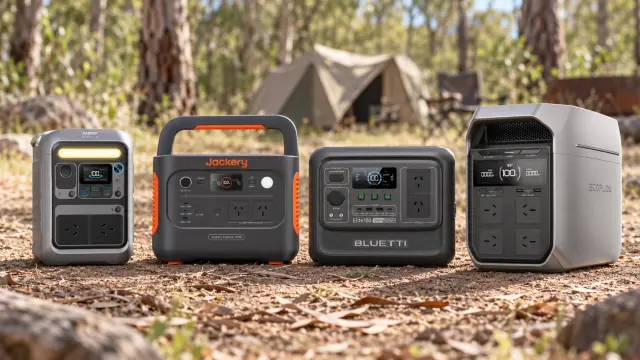
Choose portable power by what you need to run, for how long, and how far you will carry it. These five Australian models span small electronics, roughly 1kWh setups and a larger energy budget.
The shortlist
Choose for the way you’ll use it.
Options for different needs, based on manufacturer specifications and seller offers. We haven’t tested them hands-on.
For small electronics
Anker SOLIX C300 AC (A1722)
Less to carry for small jobs
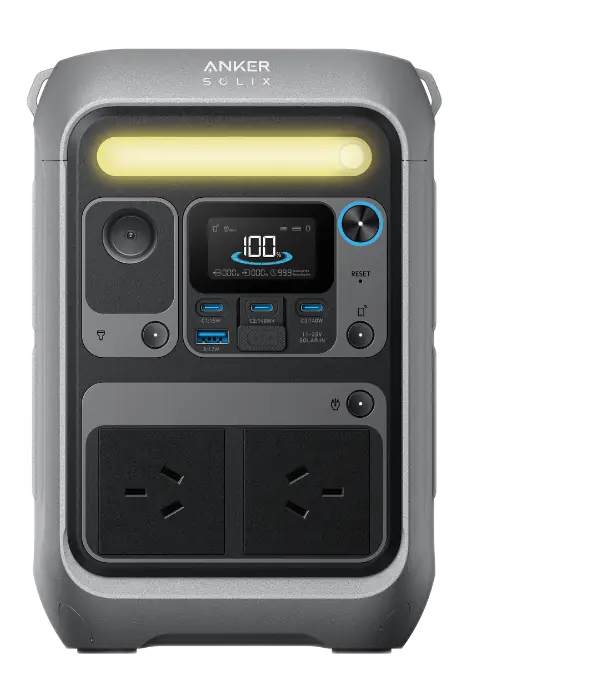
Useful for compatible small devices when the entire job fits within 288Wh of nominal energy and a 300W AC limit.
- Capacity
- 288Wh
- AC output
- 300W
- Stated mass
- 4.13 kg
The trade-offMuch less stored energy than the 1 kWh models; choose the AC configuration.
Sale price
Price perspective: A$499
Manufacturer reference: A$549
AC unit with AC cable; panel and solar cable extra; GST unconfirmed; advertised free AU shipping · Checked
Price details +
A$499 with the displayed auto-applied code; manufacturer reference A$549. Check code eligibility at checkout.
Price source ↗For carrying a roughly 1kWh station
Jackery Explorer 1000 v2 (JE-1000D)
Lower stated weight; a 1,500W output limit
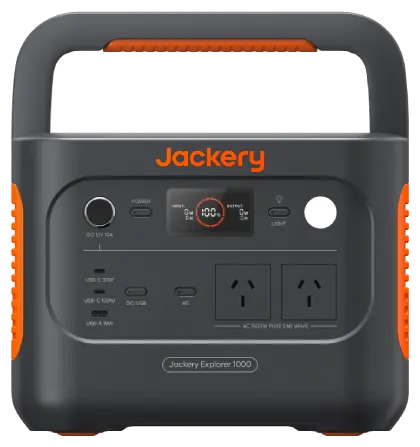
Start here for frequent lifting: its stated 10.8kg is lower than the BLUETTI and EcoFlow stations of similar capacity in this guide.
- Capacity
- 1,070Wh
- AC output
- 1,500W
- Stated mass
- 10.8 kg
The trade-offNo extra-battery expansion and a lower AC ceiling than the 1,800W choices.
Sale price
Price perspective: A$699
Manufacturer reference: A$799
Station and AC cable; tax included; solar panel and vehicle cable extra; freight unconfirmed · Checked
Price details +
Manufacturer sale A$699; manufacturer reference A$799.
Price source ↗For up to 1,800W AC
BLUETTI Elite 100 V2
A 1,800W AC ceiling in the 1kWh class
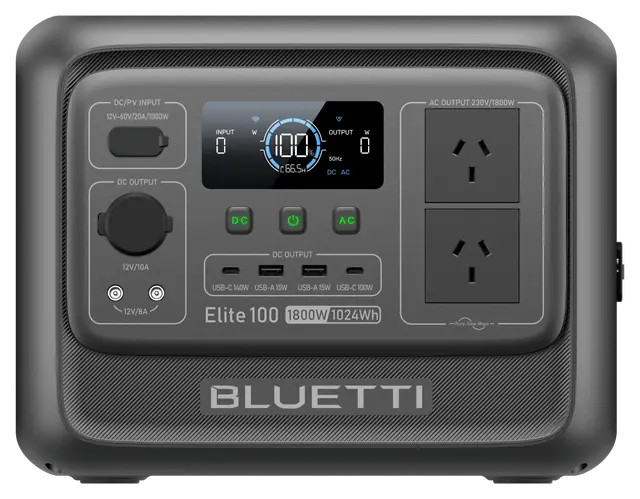
Suits a compatible load above Jackery’s 1,500W limit, without moving to a station with roughly twice the stored energy.
- Capacity
- 1,024Wh
- AC output
- 1,800W
- Stated mass
- 11.5 kg
The trade-offSolar cable excluded; capacity cannot be expanded.
Sale price
Price perspective: A$999
Manufacturer reference: A$1,299
Station and AC cable; solar panel and solar cable extra; GST and freight unconfirmed · Checked
Price details +
Manufacturer sale A$999; manufacturer reference A$1,299. Listed 20A solar cable A$59 extra.
Price source ↗For adding an extra battery later
EcoFlow DELTA 3 Plus
An expansion path and two solar inputs
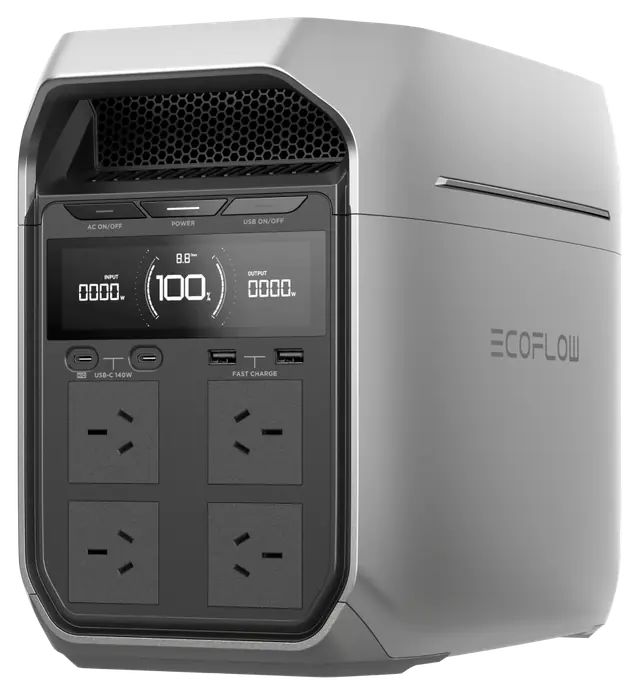
Useful if you already know why you need extra battery capacity or two solar inputs. Price those parts as part of the system.
- Capacity
- 1,024Wh
- AC output
- 1,800W
- Stated mass
- ≤12.5 kg
The trade-offExtra batteries add cost and weight; 1,800W remains the ordinary AC ceiling.
Listed price
Price perspective: A$1,599
Australian station; panels, solar/vehicle cables and extra batteries extra; GST included · Checked
Price details +
Anaconda displayed A$1,599; manufacturer reference A$1,599.
Price source ↗How we chose these options
How we compared
Reviewed
- Evidence basis
- Australian seller pages, manufacturer specifications, regional manuals and warranty terms rechecked 12 October 2026. These are researched recommendations; we have not measured performance or owned the products.
- Coverage
- Five selected Australian configurations from four brands, spanning 288Wh to 2,048Wh. Four starting points and one larger alternative.
- Limitations
- A selected comparison, not a market-wide winner. Nominal energy, surge modes and charge-input ceilings do not prove usable runtime, charging speed, noise or reliability. Accessories change the complete price.
Choose for what you need to run
If you will lift a roughly 1kWh station often and your combined loads stay within 1,500W, start with Jackery Explorer 1000 v2. Its stated 10.8kg weight is lower than the BLUETTI and EcoFlow options of similar capacity here. Choose BLUETTI Elite 100 V2 for a compatible load above 1,500W and within its ordinary 1,800W ceiling; choose EcoFlow DELTA 3 Plus if you have a defined extra-battery plan.
For phones, lights and compatible laptops, the smaller Anker C300 AC may be enough; check the whole energy budget against its 288Wh capacity. Anker C2000 Gen 2 offers 2,048Wh for larger needs, with 18.9kg to lift and a supplied-plug question to resolve before ordering.
Two numbers matter: watts (W) limit what can run together; watt-hours (Wh) describe stored energy. Neither figure promises runtime in your setup. We compare manufacturer specifications and Australian packages, without hands-on runtime or reliability tests.
Dated Australian prices
| Model / seller | Displayed price | Practical difference |
|---|---|---|
| C300 AC · Anker SOLIX | A$499 with auto-applied code | 288Wh / 300W AC; panel and solar cable extra |
| 1000 v2 · Jackery | A$699 sale | 1,070Wh / 1,500W; 10.8kg; no battery expansion |
| Elite 100 V2 · BLUETTI | A$999 sale | 1,024Wh / 1,800W; solar cable extra; no expansion |
| DELTA 3 Plus · Anaconda | A$1,599 | 1,024Wh / 1,800W; extra batteries and cables separate |
| C2000 Gen 2 · Anker SOLIX | A$2,199 with auto-applied code | 2,048Wh / 2,400W; 18.9kg; confirm supplied mains plug |
Jackery identifies tax as included. Anaconda’s terms include GST. Anker SOLIX and BLUETTI GST bases remain unconfirmed; check their itemised totals. Anker SOLIX advertises free Australian shipping; confirm BLUETTI freight. The C300 amount depends on the displayed automatic code. Manufacturer reference prices remain in the price details; they do not establish a historical saving.
Purchase checks that could change the choice
C300: small jobs, with the AC model
The Australian A1722 manual confirms AC outlets and an included wall-charging cable. C300 DC is a separate configuration without those outlets. For solar, the AC model accepts 11–28V and at most 100W; the solar cable and panel are separate purchases. That low ceiling makes it a poor match for a large panel bought without checking electrical limits. The Australian warranty lists five years; direct-store claims require proof of purchase and the serial number through Anker SOLIX support.
Jackery: carry less, accept a fixed capacity
The AU manual documents the JE-1000D’s 10.8 kg weight, AC cable and two Australian AC outlets. Check its energy-saving settings before relying on a low-load overnight device: automatic shutdown can matter even when nominal capacity looks adequate. The direct-store listing offers three years plus a two-year extension automatically for official-site purchases. Keep the receipt; warranty claims start with Jackery Australia and the policy includes battery charging/maintenance conditions. A solar panel and vehicle cable are extra.
BLUETTI: more AC output, with the solar cable extra
The Elite product’s Tech Specs and package list identify 230V output, no capacity expansion and a five-year warranty. The box includes the AC cable, grounding screw and documents. It excludes the solar cable; the listed 20A MC4–XT60 accessory adds A$59 before the panel. Its 1,000W solar ceiling is an input limit, not a guaranteed charging rate. For a claim, retain the invoice and serial number and follow BLUETTI’s Australian warranty process; confirm the exact-model conditions in writing.
EcoFlow: choose it for an expansion plan
EcoFlow’s Australian specifications give two solar inputs, each up to 500W, and name compatible extra batteries. Budget the battery, connection cables and panels separately from the Anaconda station price. The IP65 description applies to the battery pack, not a licence to expose the whole station to rain. EcoFlow lists five years in its AU warranty policy; for this retailer purchase, keep Anaconda’s receipt and confirm its claims route and manufacturer coverage before ordering.
Size the energy budget before the inverter
Capacity in Wh sets the energy budget; output in W sets what can run together. Multiply a steady device’s watts by hours. For a cycling fridge, use measured daily energy consumption, then allow for conversion losses, station overhead and reserve. A larger inverter does not add stored energy.
An illustrative calculation, not a runtime promise: 60W for four hours plus 10W for six hours requires 300Wh before losses. That already exceeds the C300’s nominal 288Wh. Starting demand needs its own check. Surge and voltage-reducing boost modes do not universally raise the normal continuous rating.
For solar, match voltage, current, connector and polarity to the exact regional manual. A matching plug alone is insufficient. Charging ceilings are useful only if your panels, conditions and time between charging opportunities can make use of them.
A larger alternative: Anker C2000 Gen 2
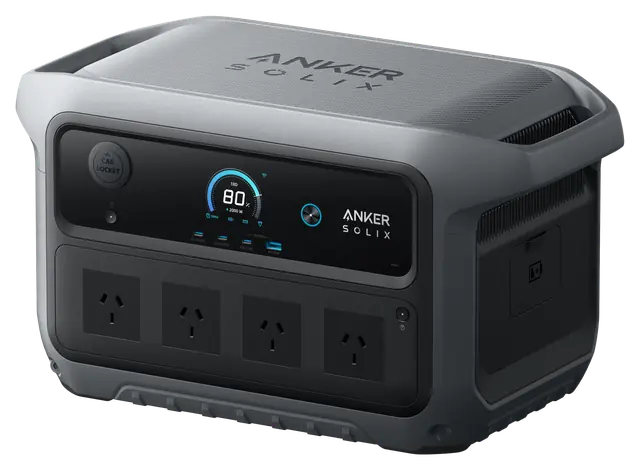
For a larger energy budget
Anker SOLIX C2000 Gen 2 (AU A1783)
2,048Wh · 2,400W AC · 18.9 kg
A$2,199 with auto-applied code · A$2,699 manufacturer reference · checked 12 October 2026
Bare station with AC cable; panels, vehicle/solar cables and extra battery separately. GST unconfirmed; advertised free Australian shipping.
View at Anker SOLIX Australia ↗The Australian offer doubles the nominal energy of the 1 kWh class and supports a separately sold BP2000 Gen 2 battery. Its weight makes frequent lifting a different proposition. The product page describes a 15A charging cable, while the AU manual specifies a 10A maximum AC input: have Anker confirm the supplied plug and your outlet before buying; do not improvise an adapter. The manual excludes the panel, solar cable and car cable from the basic package. Anker’s AU warranty table lists five years for A1783/85, with direct-store claims through its support team.
Before you order
Match the Australian model to your loads, outlet and cables; obtain the full accessory quote and retain the seller’s receipt and written warranty. For medical or critical equipment, seek the equipment supplier’s assessment: these specification comparisons do not verify continuity or reliability for that use.
Follow the operating manual and ACCC battery guidance. Keep ventilation clear and use suitable charging equipment. A portable station is not permission to connect its output to building wiring. If your task is phone charging alone, a compatible power bank may be easier to carry; hardwired household backup needs an installer’s assessment.
Check how we compare
Read the evidence basis for our product comparisons and send corrections through our contact page.
How we comparePrimary sources (17)
- Anker SOLIX Australia — shipping policyManufacturerwww.ankersolix.com/au/policies/shipping-policySource checked
- Anaconda — Australian prices and GST termsRetailer offerwww.anacondastores.com/en-au/terms-and-conditionsSource checked
- C300 AC selected Australian offer — Anker SOLIXManufacturerwww.ankersolix.com/au/products/c300?variant=50381917421866Source checked
- A1722 Australian manual — Anker SOLIXManufacturercdn.shopify.com/s/files/1/0850/1149/7258/files/A1722_V2_EN_AU_UM_Web_20240829_106955.pdf?v=1744169317Source checked
- C2000 Gen 2 bare-unit Australian offer — Anker SOLIXManufacturerwww.ankersolix.com/au/products/c2000-gen2?variant=51354457309482Source checked
- A1783 Australian manual — Anker SOLIXManufacturercdn.shopify.com/s/files/1/0850/1149/7258/files/A1783_UG_AU_EN_V1_20251229.pdf?v=1773890668Source checked
- Australian warranty and claims — Anker SOLIXManufacturerwww.ankersolix.com/au/policies/refund-policySource checked
- Explorer 1000 v2 offer and configuration — Jackery AustraliaManufacturerau.jackery.com/products/explorer-1000-v2-portable-power-stationSource checked
- JE-1000D Australian manual — JackeryManufacturerr.jackery.net/productGuide/Jackery_Explorer_1000_v2_User_Manual_AU.pdfSource checked
- Warranty and claims — Jackery AustraliaManufacturerau.jackery.com/pages/warranty-and-returnSource checked
- Elite 100 V2 offer, Tech Specs and box contents — BLUETTI AustraliaManufacturerwww.bluettipower.com.au/products/elite-100-v2-portable-power-stationSource checked
- Elite 100 V2 Australian manual — BLUETTI via BunningsManufacturermedia.bunnings.com.au/api/public/content/ebd4be93dd1c4fe39b9552adeadf72b9?v=71522d52Source checked
- Warranty and returns — BLUETTI AustraliaManufacturerwww.bluettipower.com.au/pages/warranty-returnSource checked
- DELTA 3 Plus exact offer — AnacondaRetailer offerwww.anacondastores.com/en-au/p/ecoflow-delta-3-plus-1800w-power-station/90246196Source checked
- DELTA 3 Plus Australian specifications — EcoFlowManufacturerau.ecoflow.com/products/ecoflow-delta-3-plus-portable-power-stationSource checked
- Australian warranty terms — EcoFlowManufacturerau.ecoflow.com/pages/warranty-policySource checked
- Lithium-ion battery safety — ACCCOfficial sourcewww.productsafety.gov.au/consumers/handle-chemicals-and-poisons-safely/lithium-ion-batteries-guideSource checked