
Blackout backup
Will my solar battery work during a blackout?
By CompareVolt
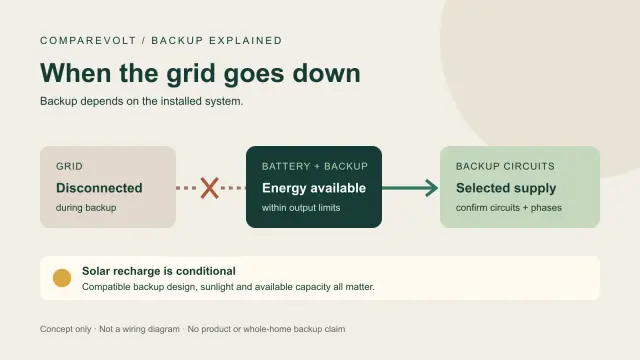
A home battery needs a backup-capable installation to work when the grid fails. Check the circuits, phase, power limit, reserve and whether solar can recharge it.
Will it keep the power on?
Yes, if your installed system supports backup and has energy available. A battery bought to reduce bills may provide no outage supply. Even a backup installation may power only selected circuits, with limits on what can run together.
Ordinary grid-connected solar usually shuts down when mains power fails. That safety function, called anti-islanding, prevents electricity feeding into the network while it is being repaired. Government battery guidance distinguishes this from a system designed to supply an isolated part of your home.
Ask for the installed backup specification. The battery's storage capacity alone cannot tell you which sockets will work.
The gateway and circuits decide where power goes
Backup equipment separates the home's backed-up supply from the failed network. The component may be called a gateway, backup box or islanding device; what is included depends on the system. For a concrete example, Tesla's Australian datasheet says Backup Gateway 2 detects an outage and controls the grid connection during backup. That describes this equipment, rather than every battery installation.
The government's design guide says outage supply must be deliberately designed and configured. Ask the seller to identify the required backup equipment, commissioning and any switchboard work in the installed quote. A battery cabinet price does not establish a complete backup cost.
A selected-circuit design might cover the fridge, lights and particular sockets. It does not imply that every kitchen socket or an appliance elsewhere in the house is backed up. Request a written circuit schedule. If the quote promises whole-home backup, also request the operating limits: connected appliances still have to stay within the available output.
This is a consumer checklist, not wiring guidance. Have the installer explain and demonstrate the commissioned backup function and provide the handover instructions.
Three-phase supply does not guarantee three-phase backup
Normal grid operation and blackout operation are different. Australian Government inverter guidance says a single-phase battery or single-phase hybrid inverter provides outage backup only to circuits on that phase, even in a home with a three-phase network connection.
For a three-phase property, ask which phase or phases remain supplied and which circuits sit on them. Ask separately about any appliance that needs three-phase power. Do not infer its backup capability from normal operation, a large battery capacity or the words “three-phase compatible”.
Solar matters too: have the installer confirm whether the existing solar inverter can operate with the proposed backup arrangement. A normal grid-connected solar installation is not evidence that its generation remains available after the grid fails.
kWh tells you about duration; kW limits what runs together
Two specifications answer different questions. Usable capacity in kilowatt-hours (kWh) describes stored energy available for use. Backup output in kilowatts (kW) limits simultaneous demand. These are separate quantities in the government's battery explainer.
Use this illustrative calculation once you know the energy deliverable to the backed-up circuits:
Runtime in hours ≈ remaining deliverable energy in kWh ÷ average backed-up load in kW.
If 6 kWh can reach those circuits and they average 0.5 kW, the arithmetic gives about 12 hours without solar. At 2 kW it gives about three hours. These are assumptions, not measurements or a model claim. Starting charge, losses, operating buffers and changing loads affect the result; do not apply an extra loss allowance if your energy figure already includes it.
Output is a separate test. In a hypothetical system with a 3 kW continuous backup limit, a 2 kW heater plus 1.5 kW of other loads exceeds that limit even with a full battery. Ask for the installed continuous backup rating and motor-start capability, rather than assuming a short peak rating can be sustained. Tesla's outage guidance illustrates why this matters: excessive starting loads can interrupt its backup supply.
A reserve keeps energy aside before an outage
A backup reserve setting can trade some everyday bill savings for more stored energy when the grid fails. Tesla's Australian explanation says its reserve is held back from normal self-powered or savings use, then becomes available during an outage. It can discharge below that setting during backup.
For illustration, 30% of a hypothetical 10 kWh usable battery is 3 kWh held aside. That is not a guaranteed three hours of electricity: runtime still depends on demand, losses and the system's operating floor. Nor does selecting 30% mean the battery has already charged to that level.
Check your manufacturer's definition and the actual charge. If you join a virtual power plant, ask the provider which reserve applies, who can change it and how dispatch interacts with household backup. Do not assume one manufacturer's controls describe another system or every VPP contract.
Can solar refill the battery while the grid is down?
Sometimes. Government guidance distinguishes battery-only outage supply from an islandable solar-and-battery arrangement that can keep charging in sunshine. Ask whether your exact installed system supports the latter.
Tesla's Australian outage page also makes solar recharging conditional on configuration. It describes reducing or stopping solar production when the battery cannot absorb the surplus, then allowing production again when it can. A pause near full charge can therefore be intentional for that system.
Plan around the energy available, rather than unlimited daytime charging. Cloud and heavy household demand can leave little surplus to replenish storage. Ask what happens after the battery reaches its low-energy shutdown point: automatic solar restart, minimum charge and recovery conditions need confirmation for your equipment. Do not assume sunrise alone restores supply. Follow the manufacturer's owner instructions if backup stops, and contact the installer when recovery is unclear.
What to get in writing before relying on backup
Use the quote, circuit schedule and handover documents to answer these questions:
- Equipment: Is blackout backup included, with the required gateway or backup device and commissioning?
- Coverage: Which circuits and phases stay live, and which appliances are excluded?
- Output: What continuous load and motor-start demand can the installed backup supply support?
- Energy: What is the usable capacity, actual charge, reserve setting and low-energy operating floor?
- Solar: Can this solar inverter recharge the battery during an outage, including after shutdown?
- Handover: What interruption should you expect during changeover, and what owner checks and recovery steps does the manufacturer specify?
Keep those answers with the system records. They let you plan around the backup you actually have, instead of treating the battery's headline capacity as a promise that the whole house will keep running.
Primary sources (6)
- Batteries — Australian Government Solar Consumer GuideOfficial sourcewww.energy.gov.au/solar/get-know-solar-technology/batteriesSource checked
- Design considerations — Australian Government Solar Consumer GuideOfficial sourcewww.energy.gov.au/solar/solar-system-design/design-considerationsSource checked
- Inverters — Australian Government Solar Consumer GuideOfficial sourcewww.energy.gov.au/solar/get-know-solar-technology/invertersSource checked
- Powerwall 3 Australian datasheet — Backup Gateway 2Manufacturerenergylibrary.tesla.com/docs/Public/EnergyStorage/Powerwall/3/Datasheet/en-au/Powerwall-3-Datasheet-AU-EN.pdfSource checked
- Backup Reserve — Tesla Support AustraliaManufacturerwww.tesla.com/en_au/support/energy/powerwall/mobile-app/backup-reserveSource checked
- Best Practices During Power Outages — Tesla Support AustraliaManufacturerwww.tesla.com/en_au/support/energy/powerwall/own/best-practices-during-power-outagesSource checked